
Cellular research
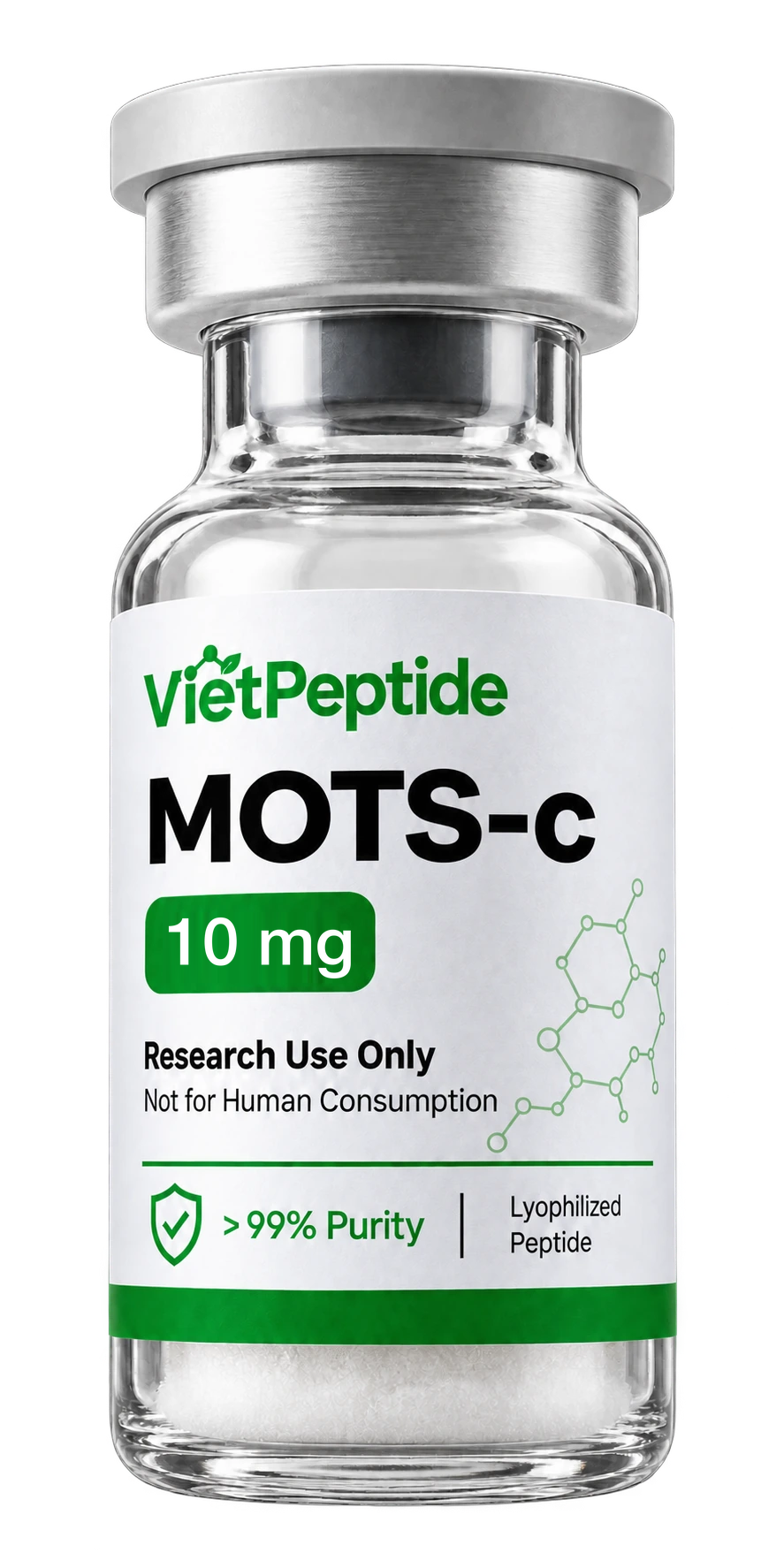
MOTS-c
A signal from mitochondrial DNA: a peptide studied for cellular energy and insulin sensitivity.
Format10 mg
From1,800,000 VND ≈ $70
StatusConfirm before payment
Format
Packaging illustration
Choose your orderVolume discount applies automatically
Free standard delivery from 2,500,000 VND
Da Nang: about 30 minutes · every other Vietnam address: 1–2 days
MOTS-c reconstitution calculator
- Labeled vial
- Swabs + syringe
- Written confirmation
Research use only
Free with every order
Alcohol swabs + mixing syringe
2+ vials = free bac water
3 ml bacteriostatic water on the house
Orders from 4,000,000 VND
10 ml bacteriostatic water included
EN · RU · VI support
Order in the language that suits you
Explore the molecule
Formats and prices MOTS-cA signal linking mitochondria and the cell
A clear starting point. Follow the research, unpack the terminology and compare related profiles.
The story behind the name
What is MOTS-c?
MOTS-c is genuinely unusual. Almost every protein in your body is encoded by DNA in the cell nucleus. MOTS-c is not. Its instructions sit inside mitochondrial DNA, in a gene hidden within the 12S rRNA region. It is one of a small group of mitochondrial-derived peptides discovered only in the last decade or so.
Research questions
What do researchers investigate?
Metabolic and exercise-related pathways
AMPK signalling in animal models
Unpack the terminology
Tap a term to see what it means.
Mitochondria
Cellular structures involved in energy conversion and signalling. Different compounds can be studied at different parts of mitochondrial biology.
Research model
A controlled system such as cells, isolated tissue or an animal model. A result describes that setting and does not automatically transfer to people.
Reading and sources
Search PubMedCompare
Put the profiles side by side
Compare research directions and labelled formats. Choose a related material to explore the difference.
MOTS-c
A signal from mitochondrial DNA: a peptide studied for cellular energy and insulin sensitivity.
Listed formats10 mg · 40 mg
NAD+
Energy metabolism and DNA repair: an essential coenzyme connecting key cellular pathways.
Listed formats1000 mg
Explore this profile Questions
A closer look at the details
What is MOTS-c?
A 16-amino-acid peptide encoded inside mitochondrial DNA rather than in the cell nucleus, within the 12S rRNA region. It is one of a small group of mitochondrial-derived peptides identified in roughly the last decade. Listed here as a non-clinical research material.
Why is MOTS-c's mitochondrial origin significant?
Because nearly all proteins are encoded in nuclear DNA. A peptide written in mitochondrial DNA that acts on the wider cell suggests mitochondria send signals outward rather than only producing energy.
What does the amount on the label mean?
The label records the amount or volume in the vial. It identifies the format; it does not define a use regimen.
Research context, not a promise of clinical effects. Read each study in its original experimental setting.
Format and price
Available options.
 NAD⁺ + MOTS‑c Longevity StackResearch protocol: two peptides combinedView protocol
NAD+ vs MOTS-cSide-by-side tableView comparison
NAD⁺ + MOTS‑c Longevity StackResearch protocol: two peptides combinedView protocol
NAD+ vs MOTS-cSide-by-side tableView comparison
Need several formats or repeat quantities? Open the bulk request checklist.
Need to check an exact format and availability? Open the current availability check.
FAQ
MOTS-c
What is MOTS-c?
A 16-amino-acid peptide encoded inside mitochondrial DNA rather than in the cell nucleus, within the 12S rRNA region. It is one of a small group of mitochondrial-derived peptides identified in roughly the last decade. Listed here as a non-clinical research material.
Why is MOTS-c's mitochondrial origin significant?
Because nearly all proteins are encoded in nuclear DNA. A peptide written in mitochondrial DNA that acts on the wider cell suggests mitochondria send signals outward rather than only producing energy.
How do I check MOTS-c availability?
Tap “Order” and choose WhatsApp or Telegram. Your chosen app opens a short message with MOTS-c 10 mg / 40 mg. Send it to check availability.
Can I pay directly on the website?
No. After confirmation, payment is accepted in VND or USD.